Sunday, January 1, 2017

Instrument Flight and a new way of doing Forced Landings!

First of all, Happy New Year and I wish all of you reading a prosperous and enjoyable 2017!

The first day of 2017 I did my first flight of the year and already I am ticking off one box of my new year resolutions (which are ALL aviation related). I begun instrument flying for my 4 hours required to be a private pilot in Hong Kong! So here are the details of the flight:

We managed to start early, an entire hour early because my instructor's student simply forgotten that he had a lesson booked for today, presumably due to the alcohol and partying from New Year's Eve. But never mind that, it was awesome we can start early as we have quite a schedule for one hour. PFLs and Instrument Flying!

After a quick preflight, we got on and got started. We taxied out to the undershoot area for our engine performance check as another one of our 172s, B-LUW followed along, the aircraft was piloted by a well-known actor in Hong Kong and he was taking his two sons up for a New Year's Day ride, which is a great father and son(s) bonding activity to be perfectly honest.

We took off into the calm skies of this beautiful Sunday afternoon and departed the Shek Kong airspace via the Fire Station Gap, which gives us a perfect view of our neighbor city, Shenzhen. However, we quickly turned back into the training area and my instructor handed me the hood, time to "TRUST YOUR INSTRUMENTS HOWARD!"

The instructor remarked that my instrument flying was "An easy A grade, CPL standard." Well I did hold altitude within 50 feet and heading within 5 degrees, I must credit this performance for my first time flying under the hood to my numerous amounts of hours in FSX. However to any students wondering, yes you do feel the illusions as taught in human factors, and it does take practice to ignore it. I felt the sensation of the aircraft banking when in reality I was wings level, however I rectified it before the bank angle even exceeded 3 degrees. This is the thing about instrument flight is that if you spot a slight deviation, fix it there and then as a small deviation will very quickly exacerbate to a huge deviation. Also limit turns to no more than 20 degrees or around rate 1.

The Constant Aspect Forced Landing Technique:
After 20 minutes, I was cleared to use the actual horizon again and I took the hood off and we proceeded to do some PFLs, this is the fun part. Instead of doing the traditional square circuit with fixed "key" points, which if you are a pilot would probably be aware that it is on very rare occasions that you actually arrive at those points at the said altitudes. So it can be said that those altitudes are absolutely worthless. This is because there are many factors that come into account, such as wind and aircraft loading or even pilot technique! But the rules of thumb stays the same, maintain best glide speed, land into wind as much as practicable.

As the engine fails, the status quo remains, pitch and trim quickly for best airspeed as you look for the best field, preferably to the left and slightly in front, however do not limit choices to only that. I will not go into incredibly technical terms when it comes to field selection. Once the field is selected then you will first plan the general flight path and only then do the checks.

As I previously mentioned, the traditional way to execute and practice forced landings is by a square circuit with fixed key points with fixed altitudes, but in practice they are rarely met with any precision. This is why the Constant Aspect Forced Landing technique is a much safer and easier option. Consider the diagrams below:

Credits to the Royal Air Force

Credits to the Royal Air Force
These diagrams make up part of the RAF Bulldog Flying Instructor's Manual the better illustrate the Constant Aspect technique. The idea is to set a high key point (only for training, in the real world it will work at most normal flying altitudes).

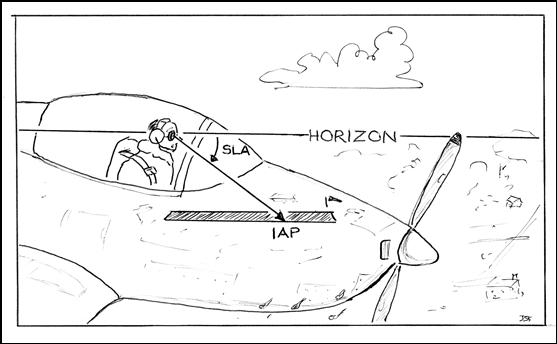
As shown on the diagram on the right, an IAP (Initial Aiming Point) is chosen which is around 1/3rd of the way down the selected landing site, and the idea is to fly a left circular pattern in order to keep the SLA (Sight Line Aspect) the same during the entirety of the circuit. This is not flown so you can maintain sight line but flown like this as it allows for better fine corrections and takes away all the complicated extrapolation and guesswork from the gliding descent. Note that one must maintain coordinated flight throughout the circular loop and also maintain the best glide speed as it will allow for the most ideal glide ratio.

As shown on the diagram below the previously mentioned diagram, the SLA Angle is the angle between the horizon and your sight line towards the IAP, and by eyeballing it should be around the neighborhood of 45 degrees so you wouldn't be too high or low. Note that while flying this technique the key positions and altitudes can be completely forgotten and your eyes should be 90% of the time looking out of the window. Basically it's like flying a straight in final approach, you keep this aiming point at the same point in your windscreen and this removes most, not all of the judgement calls you have to make during a traditional key position technique for forced landings.

The judgement calls the pilot still has to make is whether their SLA is too excessive (Aircraft too high, overshoot) or not significant enough (Aircraft too low, undershoot).

What if you are too high? First of all this is a more ideal position as it is easier to lose height than it is to gain the lost height when your engine has packed up. There are a couple of things in your power to do if this was the case:

  • Widen out the circuit - Slacken your turns a little bit and wait for the SLA to correct itself.
  • Use flaps - However be aware that premature use of flaps may cause a too low situation.
  • On final, overshoot - Like the first technique.
  • Slips - Great to lose a whole bunch of height, however proximity to Vso and the ground may be factors against such technique.
Most of the time, widening out and slacking the turns will be sufficient for the SLA to correct to a more ideal 45 degrees. Just note, the 45 degrees is just an eyeballed estimate like anything in flying, don't get out a protractor on your flight test!

Most importantly at the end of the maneuver, watch your altitude, don't get carried away with the oh so amazing glide approach thanks to the RAF. The minimum altitude according to the rules of the air is 500 feet away from any persons, structures or vessels. So remember to start climbing away at or before 500 feet to stay within the minimums!

So my advice now? Go up with an instructor familiar with this technique, or talk to your instructor about this technique and practice safely, use reasonable bank angles and watch your airspeed. Eventually you will find that you can use this technique in any sort of power off landing maneuver like a glide approach or for the Americans, the power off 180. This technique takes away all the nuanced effects of wind and load, and brings it all together with one simple rule: Keep the SLA constant, you will make it down alive. As the landing field is made, apply full flaps and complete your security checks. 

How do you improve in the judgement of overshoot or undershoot? Well it all boils down to constant practice. So maybe this will be one of your New Year's Resolutions, to practice forced landings and be a better, safer, more competent pilot.

My flight path yesterday
So that's it for now, headset review coming up next!

Have fun, fly safe

--
Howard

Sunday, December 25, 2016

Regaining Currency: Thrown in the deep end

First of all I'd like to start with an apology, I forgot to turn on my flight tracking app and therefore I am not able to provide a ground track of my circuits today.

Sorry.

However the ground track probably looks like a snake on drugs today because it is my first flight after 2 weeks (I was in Vietnam last week), and today was probably the most turbulent day I have ever flown. I dare say that there were moments where I genuinely thought I was going to lose control, and staying in control required skilful and forceful manhandling of the Cessna 172SP around the sky of the Shek Kong Runway 11 circuit.

As I arrived at the flight operations office and checked the computer for a weather briefing, it was showing winds at 080 10 gusting to 15 knots on the surface, which is exacerbated due to the surrounding terrain of the Shek Kong Airfield traffic zone. All pilots today knew about this risk and as the first slot of aircraft and pilots got underway, I went outside to see the windsock shifting and indicating gusts of indeed up to and including 15 knots. If it was a steady wind it might've been a little more manageable.

Today was also my first flight with my new pair of ANR (Active Noise Reduction) David Clark DC ONE-X headsets that I bought for $895USD off of Sporty's, that is really something to be looking forward for.

I started the aircraft up rather clumsily due to my lack of currency and proficiency caused by a short break from flying. After firing up the engine, I held the power button of the ANR unit to activate the ANR circuitry and the passive noise reduction on the headset itself was already rather impressive, however as soon as the ANR kicked in it acted like a volume knob to the engine. I can still hear everything very clearly but there's just much less of it, especially the lower frequencies which causes fatigue.

Back to the flight details! A more detailed review of this headset will hopefully be published next week.

After run-up, we lined the aircraft onto the runway for a short field takeoff which was rather interesting to say the least given the very gusty conditions. Notes of the stall horn can be heard due to our slow speed however I kept the aircraft accelerating in ground effect and eventually we climbed away into the MOD-SEV turbulence at Vy.

My first landing was an absolute mess, I turned final and initially all is well, flaps 30 and speed at 65 knots. However at short final I saw airspeed plummet to below 60 knots, something must not be right, I added power and kept the nose down, still nothing...

Added more, and more, and more...

It was a downdraft, and I realised at 1600 RPM I was basically just maintaining 60 knots and decided to focus on the aiming point and flare. I kept the power in throughout the flare which allowed me to maintain better control but I cut the power way too early and did not compensate with increased nose up pitch and ended up slamming myself down... Way to start the lesson.

Subsequent circuits comprised of a lot of flapless, and to be honest doing flapless approach and landings in these conditions are arguably very ideal, keeping the speed at 75 knots throughout the approach and reducing it to 65 gradually allowed better control feedback from the aircraft and I managed to pull off some rather smooth landings despite it being long due to lack of drag and power. As my confidence builds I used flaps 20 for landing, I trimmed and set the power for 70 knots on final which is 5 knots faster than what I usually use with flaps 30 and this time I took the power out just before the flare, smoothly. The transition was smooth and I managed to nail a textbook crosswind landing with the upwind wheel (left mains) kissing the tarmac first followed by the downwind wheel and the nose wheel.

Nailing a crosswind landing with a 15 knot direct crosswind is one of the few absolute pleasures in life, I just want to relive that moment a couple of times!

Downwind was actually the most troublesome part of the circuits today with the easterly winds stirring up a massive area of mechanical turbulence in the area, you know the yoke "jiggle" you do to keep the wings level on a gusty day during flare at slow speeds? Yes I had to do exactly that on downwind at 2100 RPM at 90 knots, that's how bad the turbulence was.

Eventually I got tired, the instructor said our slot is nearly ending so we called it a day by completing with a demonstration of an Engine Failure After Takeoff by "going around" and then cutting the throttle and landing on the remaining runway, a very interesting demonstration that did not disrupt traffic or waste any time.

Next week should be a full review of the DC ONE-X as I delve deeper into the heart of Bluetooth music listening while flying.


Until next time,
Have fun, and fly safe.

--
Howard

Sunday, December 11, 2016

Circuits! More Circuits!

Damn, it feels like I am redoing all my training from the pre-solo stage despite being officially licenced for 6 months already! But that's just part of being a pilot am I right? You're naturally a permanent student pilot because a good pilot is always learning!

So I now have 5 hours of flying here in Hong Kong and on a considerably heavier and larger Cessna 172S (I do have 1 hour on the R model, no real difference). It feels like I have to learn everything again, and just as I was about to be confident and a little too comfortable last week, today was a completely different story...

Firstly, what was last week like? Well it was wind calm with the windsock nice and drooped, however today was different, surface winds showed gusts of up to 15 knots and due to terrain around the airfield, mechanical turbulence tossed us around the sky in the circuit of Shek Kong airfield. Despite this, we continued with some more advanced circuits, such as glide approach, short field takeoff and landings and of course flapless. Flapless is very interesting due to the tight circuit in Shek Kong, once abeam touchdown point you will reduce speed from 90 knots on downwind to level flight at 70 knots and turn base at the normal 45 degree point. After turning base you will reduce throttle to near idle to compensate for the already high profile. Other than that, everything is status quo and pretty normal. Shek Kong circuits are high workload and everything happens very quickly, more often than not I find myself saying, "Cessna Uniform Whiskey late downwind 11 touch and go."

My first landing really wasn't great, I over-flared and ended up ballooning and then touching down rather hard. Another interesting point is that Shek Kong has trees on the sides of the runway and buildings on the approach end of runway 11, creating a "washing machine" when the winds pick up. It could be a nice steady headwind but as you descend below 100 feet, a headwind can turn to a gusting and shifting crosswind, which emphasises authority and strong control over a mushy aircraft at already low speeds. We rarely get any wind over here but when it does pick up, boy is it fun!

Subsequent circuits saw improvement as I can now anticipate where the updrafts or downdrafts are, worst thing was that there was a pocket of an updraft on short final, causing me to make the decision to go around once on a flapless and another time during a short field approach and landing. However both times the same words came out of the instructor's mouth, "Good decision, well done."

The instructor today taught me a trick to mastering glide approaches, I call it the, "Cut in half" method. It is really simple, when the engine quits you pitch and trim for best glide speed and then divide your circuit height to two. In Shek Kong our circuit height is 800 feet, so we pick two 400 feet reference points, approximated of course. This allows you to mentally plan forward where flap extensions should be and how the approach should be flown, and allowed me to be not too high but not too low every time.

Today knocked me out of my complacency, however also gave me more confidence with dealing with circuits and recognising the idiosyncrasies of the Cessna 172S, below is the track log for today's circuits. Note that I made the mistake of forgetting to activate the tracker before takeoff so I did it mid-flight.

Various lengths of final approaches
due to various types of approaches
 So that's it for today! Also I have ordered a new pair of David Clarks DC ONE-X headsets, my first pair of ANR headsets so be prepared for a flight review of that! Also next week I will be on holidays in Vietnam, so I will be back the week after.

Have fun! Fly safe!


--
Howard

Saturday, December 3, 2016

A Weekend of Flying.... With an unexpected twist!!!

"OH HELL YEA!" I exclaimed awkwardly when I managed to book another flight after my flight on Saturday for the next day, Sunday! It is very rare here in Hong Kong that we get to fortune and blessing to be able to fly for both days of a flying weekend, but here I am happily trodding home after a smooth and fun flight on a Saturday afternoon.

3rd December, 2016:
Ergh... Way too early for this pilot shit.
That was what I thought as I got myself out of bed this cool Saturday morning, but at least I was going flying. I checked the bookings to reconfirm my aircraft placement, and it's correct and I am flying B-LUW, my favorite and the club's newest Cessna 172SP Skyhawk. It has an awesome climb prop and a very smooth running engine as well as some nice leather upholstery to top that up. Eventually I got myself up and running and went off to the airfield. The weather was a very hazy morning but I am very excited to get this first flight of the day going, as I joined the convoy of the flight ops directors and other pilots, we happily drove to the flight ops office and got everything sorted for the day. This includes turning on nearly anything electrical, especially the coffee machine (ain't that true!) and ringing the Civil Aviation Department to fax us a copy of the latest NOTAMs for the day. 

My instructor came very early and already completed the preflight inspection, I went out there and called for fuel and did it once again for proficiency and everything looks great, weather isn't but it is flyable. 

We set off and departed overhead to Kadoorie Gap into New Town and then to Tolo, he wants to see some of my general handling of the Cessna 172 and this flight was to get my head back into the 172, and also to fly some circuits as well. Visibility was barely 6km and there were an uncomfortable amount of helicopters around, because for some reason or another the visibility never seemed to phase the rotorheads. We made the safe call and decided to call it quits in the training areas and returned back to Shek Kong for some circuits to look at my landings. 

Shek Kong has a tight approach, mainly due to built up areas and the fact that high terrain surrounds the aerodrome, which is challenging as Shek Kong rarely gets any wind and the Cessna 172 can be very slippery despite having throttle at idle and flaps to 30 degrees. I consistently end up high on approach on the first two touch and goes and land long, but my hold off and flare technique was improving and some landings could've really been called, "Greasers." 

After experimenting with power and flap settings, we found the perfect compromise, on base we pull the throttle to very near idle and dump full flaps early and now my landings are nearly perfect, but could use with a bit more hold off.

That was 0.8 hours of Saturday done! Phew it was tiring, high workload but all in all some great fun and I got the privilege to learn from one of the most experienced instructors of our club.

So in a nutshell, I gotta still get used to how much the Cessna 172 floats in ground effect despite its weight compared to the Sling, and really I just have to be more patient and let the aircraft settle. It's some great news that the next day (today as I am writing this article) I am flying again as this will help consolidate my knowledge even further.

4th December, 2016:
Not so early today! Which is good, extra 45 minutes of sleep for me and a more normal schedule as I usually fly this slot. This time I am flying one of the oldest Cessna 172s in our fleet, which is a Cessna 172R. The registration will be withheld and this will be apparent as the story progresses. I arrive one hour earlier today which is normal for me as I do like to hang out and ask for some PIREPs from other pilots in the club, checking the weather it was just like yesterday, hazy with light winds. However today will be a complete circuit lesson, so this wasn't really phasing me at all, the wind was almost calm on the ground. 

I witnessed the beginning of the first slot, target engine start time for all aircraft will be around 9.00am as them must return for the second slot at 10.00am, however today was a slow and sluggish start with two aircraft starting literally 15 minutes before the slot ends. One aircraft, Papa Lima managed to snag in a couple of circuits before having to return and hand over to the next pilot but another one also in the run-up undershoot area, which is the 172R I will fly today spent an unusually long time doing the run-up, which is a fair cause for concern. I went back into the flight operations office as I heard his radio call, "Can someone please call the engineer to come down for some assistance? The oil pressure just dropped off."

My heart sunk, great, no flying today then. We decided to wait for the doctor's diagnosis and treatment. After the most frustrating and agonising half an hour wait, we got the green light and the flight operations director said, "She is fixed!"

There was a collective sigh of relief as the flying day seemed to be back on track for this aircraft, and not only I can fly, but the pilots who will come after me can enjoy the skies today likewise. I walked out to the maintenance hangar and a mechanic gives me the green light and I begin my normal preflight of this rather alien aircraft to me, I have never flown her before. My first impressions was that this aircraft is old, like properly old. The white paint on the wings and fuselage were wearing off with sections of bare metal showing, the flap hinges were showing bare metal but are all secure and safe, the avionics master switch was still the single rocker switch unlike the split rocker used now so the pilot can manually control avionics bus 1 and 2 independently. A sign of her age...

Despite her mature age, everything is looking good and I completed the preflight with confidence, especially the fact that the oil is completely topped off. Oil pressure? Shouldn't be a problem at all right?

Instructor showed up, we clambered into the aircraft and started her up, we are running late and both of us are eager to get going. However the instructor was the one I flew with yesterday and his wealth of experience tells both of us that these maintenance flights do have more inherent risks, and we agree that we should extensively monitor the oil pressure together to ensure that the previous problem will not return. Remember kids, your instructor is not only an instructor, use him/her as a pilot monitoring like the airlines, split the workload and practice CRM techniques!

We took extra caution as we advanced the throttle for our run-up or engine performance check, the oil pressure rose and stabilized in the center of the green arc which is completely as expected and both of us decided it was wise to advance and retard the throttle to check the fluctuations and/or drop in oil pressure as reported by the pilot prior to us will not occur, it seems to all be working as good as new! We did our pre-takeoff checks, lined up and I advanced the throttle and rotated smoothly at 55 knots for some circuit work. 

At this point I felt sure that the engine issue was fixed and that it was only a momentary hiccup, the engine was running just fine and we did everything in our power on the ground to ensure maximal safety. 

Once again, this aircraft, unlike the aircraft I flew the day before had a cruise prop instead of a climb prop, so I ended up high again. This time I had to go around once because I was really fast and high on final. Just sound decision making, going around is not a sign of failure! In fact it is a sign of good airmanship, judgement and maturity.

Subsequently, I flew the circuit at a lower power setting and lowered flaps and pulled power back further, and this time I am really starting to see a consistency in my landings. Approach, hold off, establish landing attitude and hold off even more and the main gears just squeal softly as we kiss the tarmac. Flaps up, retrim, check sufficient runway remaining and full power!

This was around our 4th circuit (nobody bothers to count them) and on upwind my instructor, in an alarmed tone said, "The oil pressure again!" I was at full power, a higher than normal oil pressure is acceptable as long as it's in the green range but not this time, the oil pressure has dropped off again! This time in an inopportune moment, up in the air.

I continued hand flying as I reduced power to level off on downwind and decided to make this one a full stop, if there is any doubt, there is no doubt! He decided to cycle the throttle through but the problem is not alleviated, we have now lost oil pressure. I observed the oil temperature needle and said, "Temps are stable."

In fact just after I said that I observed a definite but small rise in oil temperature, oil pressure is still gone, but now the focus has shifted to getting this plane on the ground. The engine still hadn't seized, and I did my normal base turn and aggressively slowed the aircraft to prevent another go around, we might not have the opportunity to. On final, the runway was clear and my approach was well stable at 65 knots with a tiny touch of power, despite the engine troubles I wanted this landing to be consistent so instructors further on will have the confidence of sending me solo again. I did my best to suppress the thought of the engine hiccups, I would definitely make the field if the engine seized up here so really I wasn't worried at all!

Above the piano bars I pulled the last couple of hundred RPM of power to idle and began to level off for the roundout, eyes to the end of the runway. Hold it, hold it, let it settle and just like magic, we are on the ground again! Not a shabby landing at all! On centerline, a little bit firmer but still smooth and I smoothly applied the brakes. 

Now as we backtracked the runway we had the time to relax and do more troubleshooting, the gauge sometimes risen to normal levels but drops off again, the oil temperature is higher than normal but stable and there is no burning odor. We taxied back in and was met by an engineer, I shut the aircraft down and we towed her back to the spot as my instructor ran off to talk to the Chief Ground Engineer.... Again.

"Sorry mate, I am so sorry but this aircraft is not safe to fly again!" I said to the next pilot, a CASA CPL holder looking to fly today, fortunately he understood and said, "At least you are alive and well."

You will rather be on the ground, wishing you were in the air.
Than be in the air, wishing you were on the ground.

Today I was edging to being in the air, really wishing I was still on the ground, we pilots have an inherent urge to fly anything with two wings and a propeller up front, but sometimes we must remember that we are indeed safer on the ground. Today was a reminder that despite the engineer giving the green light, it doesn't mean you can slack off in the air, just because the engine was worked on doesn't mean the risks aren't here. In fact there are more risk factors after a maintenance tweak, and all pilots should be aware of this fact. At the end of the day, ask yourself:

Is it you that is flying, or is it the engineer?

So until next week...

Have fun, and fly safe.

--
Howard  

Sunday, November 27, 2016

Flying low with LOW

So Hong Kong Aviation Club has now got a "new" Cessna 152 II in their fleet, registration B-LOW, and today I flew the Cessna 152 for the first time in my life and I have got to say, the 152 has a soft spot in my heart. She is absolutely lovely to fly and despite her age, is still unquestionably one of the best training aircraft ever built by Cessna. 

Today I arrived at flight operations on what was a cloudy day with scattered clouds lingering at around 2500 feet, remnants of the most intense northeast monsoon that has ever hit Hong Kong in the past decade. The weather certainly wasn't great but definitely flyable and made for some very beautiful views.... that I wasn't able to capture because I was so busy flying as this was in essence a check flight to check my competence in all the basic lessons from Effects of Controls to stalls and slow flight, which is part of my journey to acquire my Hong Kong Private Pilot License after finishing with my Recreational Pilot License in Melbourne, Australia. 

Flying out to Tolo, it was bumpy and we encountered some moderate turbulence, however the aircraft was performing better than book figures, at 2300 RPM we were seeing 95-100 knots indicated, very impressive for a nearly 40 year old Cessna 152. The airframe was as if she was still factory new and the McCauley propeller was smooth and well polished, signs of impeccable maintenance and attention to detail. The clouds were not as low as reported and we climbed all the way to 3000 feet, our vertical limit in Tolo.

It is a shame that I did not manage to take any pictures at this stage, as the view reminded me and my instructor who had been flying for more than 30 years as to why we fell in love with flying, oh for I have slipped the surly bonds of Earth! The clouds were reminiscent of blankets of white sheets covering the mountains that surrounded the Tolo Harbor, with a continuous scattered layer far above us and a grey but very calming tone. We did not speak much except for when I broke the silence by stating, "My goodness it's beautiful." After enjoying the beauty of the situation, we broke into airwork mode and did steep turns and slow flight to see how I'm going, it all went fine however the instructor is a perfectionist which is great. High standards are what make great, safe and competent pilots after all, and being new to the aircraft type is no excuse really. 

After the airwork we flew into Port Shelter via the Eastern boundaries of the sectors in order to familiarise myself with where I am authorised to fly solo in as a student pilot, it was all in all very important information and nothing really can beat the view, it was beautiful this morning. As we were returning for Tolo and back to Shek Kong, we descended to 500 feet for minimum level operations, we were flying low with the LOW!
500 feet over the Tolo Channel? Hell yeah!
It is a requirement to be familiar with low level flying, as the effects of wind is more profound down at low altitude, it is important not to have a temptation of using throttle to control groundspeed, as one must remember that airspeed is still the primary measure of aircraft performance! Which is what the low flying exercise is about, to allow the pilot to notice and acknowledge the visual illusions that can be experienced while down low.

It really isn't so hard, my tip for any student going to do low level navigation is to just treat it as if you were flying at normal altitudes, however be wary of going below 500 feet as it will be a violation of the rules of the air!
Wind drift and effects are more pronounced down here!

Returning to Shek Kong via Kadoorie, we climbed back up to 2000 feet and followed another helicopter in through Kadoorie, we did a normal overhead circuit join from 2000 feet right down to circuit height of 800 feet on downwind, and the Cessna 152 is much more responsive than the 172 in the circuit, and as it is less powerful it is slower despite the impeccably maintained engine and smooth airframe, we got around 95 knots on downwind which is a welcome speed for 172s as this means that we match their speed on downwind, another plus of the LOW. The flaps pitching moment is more pronounced in the 152 due to a lighter airframe and generally lighter and much more responsive flight controls reminiscent of the light sport aircraft type that I flew in Australia. Flying on final with flaps at 30 degrees, 60 knots is just about right for 2 men and half fuel in the tanks. However my landing today was less than desirable, I flared way too early and aggressively and my instructor caught it and helped me correct in time, it was poor judgement to flare so early with so much back pressure, perhaps this is a habit brought upon by predominantly flying much heavier 172s, which require a much more pronounced pull on the elevator.

All in all, the 152 left a great impression for me, and I will continue flying 172s for my next lessons however the 152 is also a welcome option for my flying, ultimately they are both great training aircraft, docile and very conventional to fly.

So that's it for this week! Next week will be flying a 172R for the first flight of the day!

Have fun, fly safe!

--
Howard

Sunday, November 13, 2016

Weather reports can lie: Lessons learned flying in (near) IMC + Intro to instrument flight

Are you sure about that few layer reported?

Looking at the photos taken on this morning's flight, you might be asking, "Howard, did you just take up instrument rating before your PPL?"

No, I didn't, that is not possible. However, today I went up with a highly experienced instrument rated instructor for some advanced stalling and slow flight over the training sector of Tolo Harbor, everything seems routine, Kadoorie Gap, our exit route was unobscured and weather was showing FEW022 SCT040. Few layer? Oh that should be fine, we planned to execute the maneuvers at or above 2500 feet to give us plenty of breathing room.

So we went up, expecting this to be any other flight and as we exited Kadoorie Gap, we encountered some moderate mechanical turbulence stirred up by the mountains but other than that everything was status quo.

As we turned right to avoid the built-up areas, I have transitioned to instrument flight as my instructor observed a sea of scattered layers at around 2000 feet, which is completely different from the reported FEW022 SCT040. I expressed concern however the instructor was instrument rated and we had clear outs, we continued the flight.

We managed to find a rather large hole in the clouds and we went for it, I did my first instrument-only climb and honestly it was easier than I thought, basically a combination of what you have learned on your first lesson of ground school.

Power + Attitude = Performance

Using my attitude indicator as a primary control instrument, I managed to execute a level climb at Vy to 2500 feet, without looking outside whatsoever. However this flight cannot be logged as instrument as we stayed in VMC, albeit very marginal. I wasn't under the hood, however. 

After the flight I was talking to a potential student going on her first sector solo, and I pondered the question, "If I was PIC with a PPL, would I still have continued my flight after exiting Kadoorie?"

I mean sure, I could've flown below 2000 feet, maybe 1800, or 1700, however the thing about the clouds is that a reported cloud elevation can be completely different. With the knowledge that the aviation weather report already gave erroneous reports, one must ask himself, "What more is there hidden behind this veil of clouds?" 

So no, with such marginal weather and unpredicted and unreported conditions, I would have done an immediate 180 and returned to the safety of Shek Kong Airfield. Interestingly, as the flight progressed we did enter some conditions very close to IMC and the instructor performed a well executed emergency spiral descent, that was so cool and reinforced my idea that emergency spiral descents should really be a PPL requirement worldwide. 

At the end of the day, safety really is above all, and as astronaut and pilot Frank Borman once said:
"A superior pilot uses his superior judgement to avoid
situations where he may need his superior skills."

It was a great experience today, humbling and definitely has taught me many new skills I can use in the future to make me a safer and more competent pilot.
Post flight selfie!!! I'm chuffed!
So that's it for this week!
Have fun, fly safe!

--
Howard

Friday, November 4, 2016

Improving as a pilot, "A good pilot is always learning!"

Now I can't fly this Sunday because the airport operator (the military) has some operations to do, so how exactly do you maintain proficiency as a pilot?

Not to sound cliche but the old saying, "A good pilot is always learning" is absolutely, 100% true. As a certified pilot, and a pilot who is working for higher certification levels, namely the Private Pilot Licence currently, I always look for ways to improve myself and become a better pilot every day. Not every flight! But every DAY!

Every flight I aim to be a little more precise, a little safer and fly closer to perfection than the previous one, it is key here to set a high standard, with or without an instructor onboard. This is an imperative I think if you want to prosper in this demanding industry of aviation, and you must be "spring-loaded" for any eventuality.

I have trained myself for one mindset:
Anything can happen, anytime.

While in cruising flight, many pilots always talk about getting, "Fat, dumb and happy." I will replace the word "happy" to "dead." A pilot can never sit back and relax in the flight, that is my own opinion. Now I am not saying we can't enjoy ourselves while flying, as I fly for the enjoyment aspect as well as the learning aspect but I do have two exercises while in straight and level, cruising flight where nothing much happens. It will keep you in the loop of information, therefore maintaining situational awareness.

#1: What if *enter emergency situation*?
Yes, this is actually pretty fun and keeps you on your toes at all times during any phase of the flight. To be "Spring-loaded" to survive, you must mentally remember some of the principles behind any emergency.
Engine Failure - Minimise drag --> Pitch and trim for best glide speed
Aim to general area of preferred landing spot.
Engine Fire - Remove element of fuel from the triangle of fire --> Fuel shutoff valve close, throttle open wide to allow excess fuel to be burned.
Electrical Fire - Remove electrical charge, allow for breathing --> Avionics and master OFF, open cabin windows.
If emergency descent required - Maximise drag --> Gear down, flaps down, throttle idle, turn left or right more than 30 degrees, maintain a maximum allowable speed for set configuration.
This should be done constantly throughout the flight, always have a mental picture as to what you will do in case of these situations, maintain situational awareness and exercise good airmanship.

#2: FREDA
Now I know the Brits who read this blog will be saying, "This is a given! Why wouldn't anyone do this?"
Lads, you will be surprised that as far as I know, no other syllabus teaches FREDA. It's all good that Aussie trained pilots (like myself) does the ALAP (Attitude lookout attitude performance) work cycle constantly, but I still believe combining it with FREDA makes for a better option to maintain situational awareness.
FREDA stands for
Fuel - Sufficient, selector as required
Radio - Set as required
Engine - Oil temps and pressures in the green band
Direction - Correct, DI to compass synced
Altimeter - Flying at constant altitude, QNH set to local pressure setting
I personally do the FREDA check before every frequency change, or after 15 minutes of cruising flight, despite not embarking in long cross countries.

Situational awareness is a saving grace for any pilot, and is what will allow the pilot to spring into action, with no moment of panic and disbelief after an emergency situation if it were to ever arise. As pilots we always want to accept that aviation is safe, however I would like to put it this way:
You are only as safe as you make yourself.

General Aviation is already under scrutiny by the public light, and as pilots it is our responsibility to improve the safety of GA, so we can have better reputation in the future years, and attract more people to become pilots.

I am looking forward to fly again next week, and until next time...

Have fun, and fly safe!

--
Howard Lau